
Wythe County Court Records After Arrest
Wythe County court records after arrest can pass through more than one court. The county courts page identifies General District Court as the place for traffic infractions, misdemeanors, preliminary felony matters, and civil claims within its limit. That means many jail arrests start there, even when the final felony case later belongs in Circuit Court. Circuit Court handles felony trials and other higher court matters. Juvenile and Domestic Relations District Court handles juvenile and family-linked cases, which can be more restricted than adult criminal cases.
The local path is compact but not simple. An arrest may be made by the Wythe County Sheriff's Office, a town police department, Virginia State Police, or another agency with authority. The person may pass through the magistrate process at the Wythe County Judicial Center, be booked at New River Valley Regional Jail, and then have charges reviewed by the Commonwealth's Attorney. For custody and booking details, use Wythe County jail inmate records. For booking-photo questions, use Wythe County jail roster mugshots. The court record is the source for filed charges and case disposition.
The county roster and the court case can disagree at first. A jail entry may show the arrest charge used at intake, while the court record may show amended, reduced, dismissed, or added charges after review. That is why a Wythe County court records after arrest search should check both systems before treating a charge list as final.
Find Wythe Court Records
Virginia provides separate online case systems for different court levels. The Virginia case-status hub is the safest starting point when the court level is unclear because it links to the General District, Circuit, and Juvenile and Domestic Relations systems. Wythe County misdemeanor cases and felony preliminary hearings usually point first to General District Court. Certified or indicted felony matters may then move to Circuit Court.
The Wythe County courts overview gives local court context, while the state portals provide searchable case data. When an arrest has just occurred, the case may not appear online at once. The NRVRJ roster may show current custody sooner than the court portal, but the portal is still the better place to confirm filed court charges, hearing dates, and disposition once the case is entered.
| Portal | Search Fields | Best Use |
|---|---|---|
| General District Court Case Information | Locality, name, case number, hearing date | Traffic, misdemeanor, and felony preliminary matters. |
| Circuit Court Case Information | Locality, name, case number, hearing date | Felony cases and other matters entered by circuit court clerks. |
| Case Status and Information Hub | Links by court system | Starting point when the correct Wythe County court is uncertain. |
The Virginia court case-status hub is the matching source for the screenshot below.
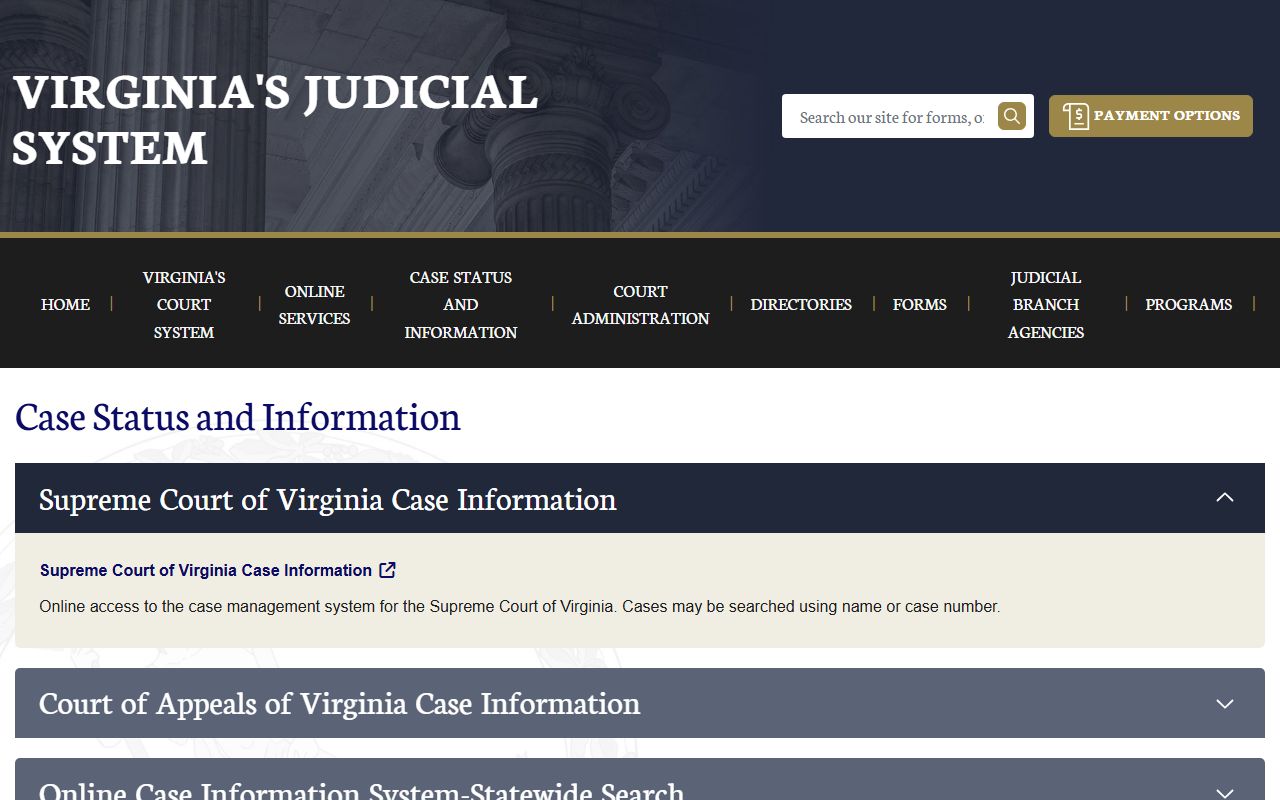
Use the hub as a routing page, then choose the court level that matches the charge path.
Wythe Arrest to Court Path
A Wythe County arrest does not become a final court result at booking. The first custody record starts when law enforcement makes the arrest or serves a warrant. A magistrate or court then handles early release decisions. If the person is not released, New River Valley Regional Jail may book the person into regional-jail custody. The first court appearance follows in the correct court, and the Commonwealth's Attorney reviews what to prosecute.
- Arrest, summons, or warrant service starts the criminal process.
- A magistrate or court reviews probable cause and release conditions.
- Jail booking at NRVRJ occurs if the person is not released right away.
- General District Court commonly handles misdemeanors and felony preliminary hearings.
- The Commonwealth's Attorney may prosecute, amend, reduce, dismiss, or present charges for indictment.
- Circuit Court becomes the key court for many felony cases after certification, indictment, or information.
Wythe County's local court cluster matters for record tracing. General District Court is listed at 245 South 4th Street, Suite 205, Wytheville. Circuit Court is listed at 255 South 4th Street, Room 105, Wytheville. Juvenile and Domestic Relations District Court is listed at 225 South 4th Street, Suite 204. The magistrate process is tied to the judicial center and has 24/7 video access for citizens and law enforcement, so warrant, bond, and first appearance details may start there before a public court record is easy to find.
Charging Documents After Arrest
Filed charges appear through a charging document, not through the mugshot or the roster by itself. Virginia cases may begin with a complaint or warrant-linked process, then move to a prosecutor-filed information or a grand jury indictment depending on charge level and court path. The exact document matters because it tells the reader whether the case is still at an early allegation stage or has moved into a formal felony posture.
| Document | Who Uses It | What It Means |
|---|---|---|
| Complaint or warrant-based charge | Law enforcement, magistrate, or prosecutor process | Often starts the case after arrest or summons and may appear in district court. |
| Information | Commonwealth's Attorney | A prosecutor-filed charging document used for some felony proceedings. |
| Indictment | Grand jury and Circuit Court process | A formal felony accusation that moves the case into Circuit Court. |
The Commonwealth's Attorney for Wythe County is listed in county court directory material as Michael D. Jones. Virginia uses the title Commonwealth's Attorney, not District Attorney. That office prosecutes criminal cases from the court side, while NRVRJ maintains the custody side of the record.
Wythe Charge Status Records
Charge status is the part of the Wythe County court record that changes as the case moves. A booking charge can be a starting label. The court record may later show that the charge was amended, reduced, dismissed, nolle prosequi, convicted, deferred, or appealed. Nolle prosequi means the prosecutor declines to pursue that charge at that time. Deferred means the case is held under court terms before a final outcome.
| Status | Meaning in Court Records | Why It Matters |
|---|---|---|
| Pending | The charge is open and has no final disposition. | Do not treat it as a conviction. |
| Amended or reduced | The filed charge changed after review or hearing. | The court record may differ from the jail booking entry. |
| Dismissed | The court ended that charge without conviction. | It may support later expungement questions if eligible. |
| Nolle prosequi | The Commonwealth's Attorney chose not to proceed on that charge then. | It is not the same as a guilty finding. |
| Convicted | A guilty plea, finding, or verdict was entered. | Sentencing and VADOC custody may follow in some cases. |
Bond After Wythe Arrest
Bond is set through magistrates and courts, then reflected through jail and court records. For a newly arrested person, the magistrate may set release conditions, require secured bond, release the person on personal recognizance, or leave the person with no bond until a judge reviews the case. NRVRJ bonding details should be confirmed with the jail because the official bonding page does not provide a full public payment-method table.
| Bond Type | How It Works |
|---|---|
| Personal recognizance or unsecured | Release depends on a promise to appear or an unsecured amount. |
| Cash bond | Money is paid directly to secure future court appearance. |
| Surety bond | A licensed bondsman posts surety after confirming the court and bond terms. |
| No-bond hold | The person cannot be released at that stage or must see a judge. |
| Detainer or hold | Another agency, case, VADOC matter, federal hold, or ICE issue may block release. |
Call NRVRJ bonding information and the appropriate court before traveling to post bond. A person can have one local bond and still remain in custody because of a detainer, another warrant, or a court order.
Wythe Warrants and Arrest Records
No official Wythe County public active-warrant search was located in the county or sheriff sources. Warrant questions should route to the Wythe County Sheriff's Office, the relevant court clerk, or an attorney. The sheriff's office handles law enforcement, arrest, courthouse security, civil and criminal papers, inmate transport, and jail functions, so it is a logical starting point for recent warrant service or very recent custody.
Warrants connect to court records in several ways. An arrest warrant authorizes custody for a criminal allegation. A bench warrant often follows a missed court date or violation of a court order. A capias directs law enforcement to take a person into custody. A fugitive warrant or out-of-jurisdiction hold may explain why a person remains at NRVRJ even when local bond appears to be addressed. Federal fugitive questions route to the U.S. Marshals Service Western District of Virginia rather than to a county warrant page.
Note: The Wythe sheriff app supports tips and public-safety news, but no app-based warrant lookup was documented.
Charges Versus Convictions
An arrest charge is an accusation, not a final finding. This distinction is central to Wythe County court records after a jail arrest because a roster entry may look firm while the court case is still pending. The court file is where the filed charge, hearing path, plea, verdict, dismissal, or sentencing result is recorded. Background checks, housing decisions, employment decisions, and credit decisions have separate legal rules and should not rely on a casual public-record search.
| Point | Charge | Conviction |
|---|---|---|
| Stage | Accusation filed after arrest, summons, warrant, or prosecutor review. | Final guilty finding, plea, or verdict. |
| Proof level | May rest on probable cause or filed allegation. | Requires the criminal-case standard for conviction. |
| Where checked | Court portal and sometimes jail roster for booking label. | Court disposition and, if sentenced to prison, VADOC records. |
| Practical warning | Can be amended, reduced, dismissed, or nolle prosequi. | Can affect sentence, supervision, and later record access. |
Sealed and Expunged Records
Virginia public access rules do not mean every arrest-related record stays public in the same way forever. Code of Virginia § 19.2-392.2 provides expungement rules for qualifying police and court records. A person asking about expungement should use the court record to identify the exact charge, disposition, and case number before taking the next step.
| Point | Sealed | Expunged |
|---|---|---|
| Public view | Access is restricted from ordinary public inspection. | Qualifying police and court records are removed from public access under court process. |
| Best record to check first | Case number, charge, and disposition in the court portal. | Case number, charge, and disposition in the court portal. |
| Effect on private sites | Does not guarantee removal from every nonofficial copy. | Does not guarantee removal from every nonofficial copy. |
Important: Wythe County Inmate Population is not a consumer reporting agency, and public case data cannot be used for FCRA-covered decisions.
Virginia Court Access Rules
Virginia FOIA and court-access rules create the public path, but they also set limits. Code of Virginia § 2.2-3704 covers public-record request procedure and allowed charges. Code of Virginia § 2.2-3706 covers law-enforcement and criminal-record disclosure, including adult arrestee and incident information. Juvenile matters, sealed files, expunged records, and some ongoing-investigation materials may not be available through ordinary public search.
For records that are not online, ask the custodian that holds the record. Court case documents route to the court clerk. Arrest and law-enforcement records route to the arresting agency. Regional-jail custody records route to NRVRJ. A strong request names the person, approximate arrest date, case number if known, booking number if known, and the agency involved.
The Wythe County courts page is the matching source for the local court screenshot below.
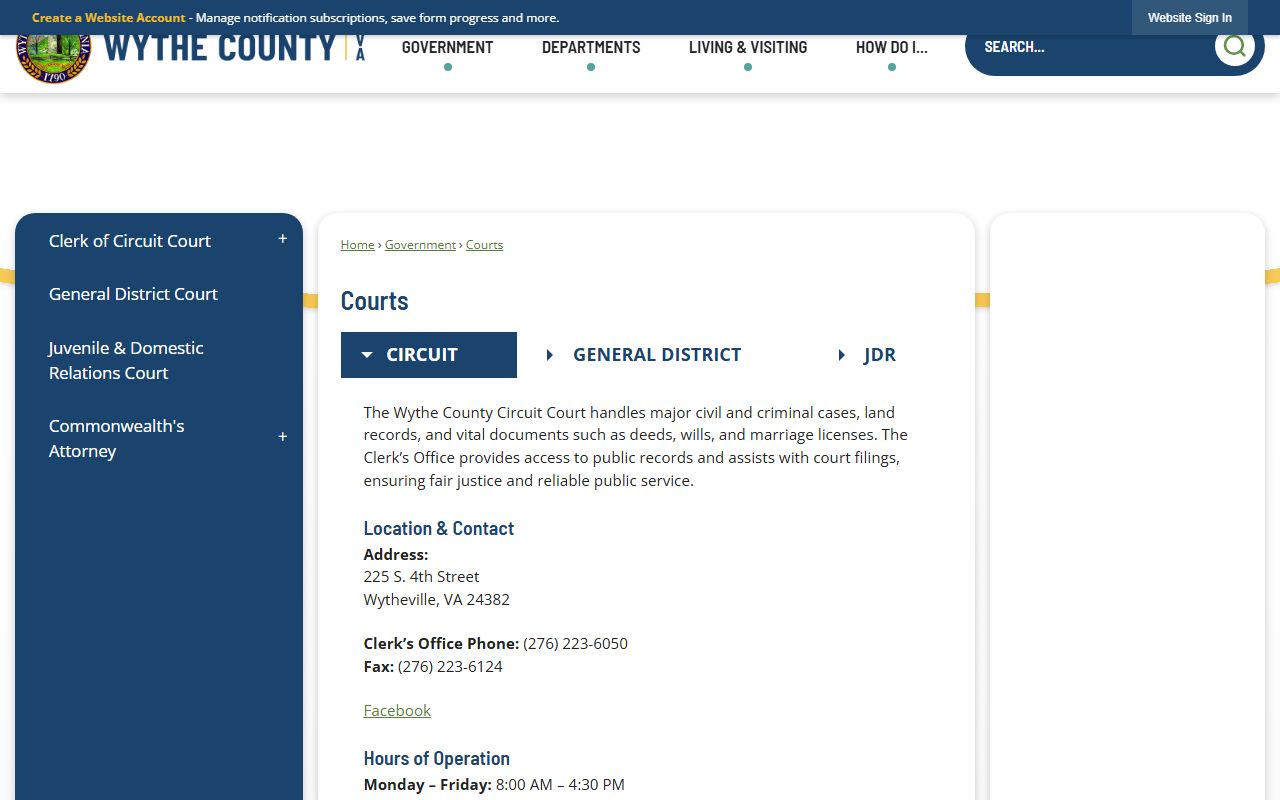
Use local court pages for office routing, then use the state portals for searchable criminal case status.